
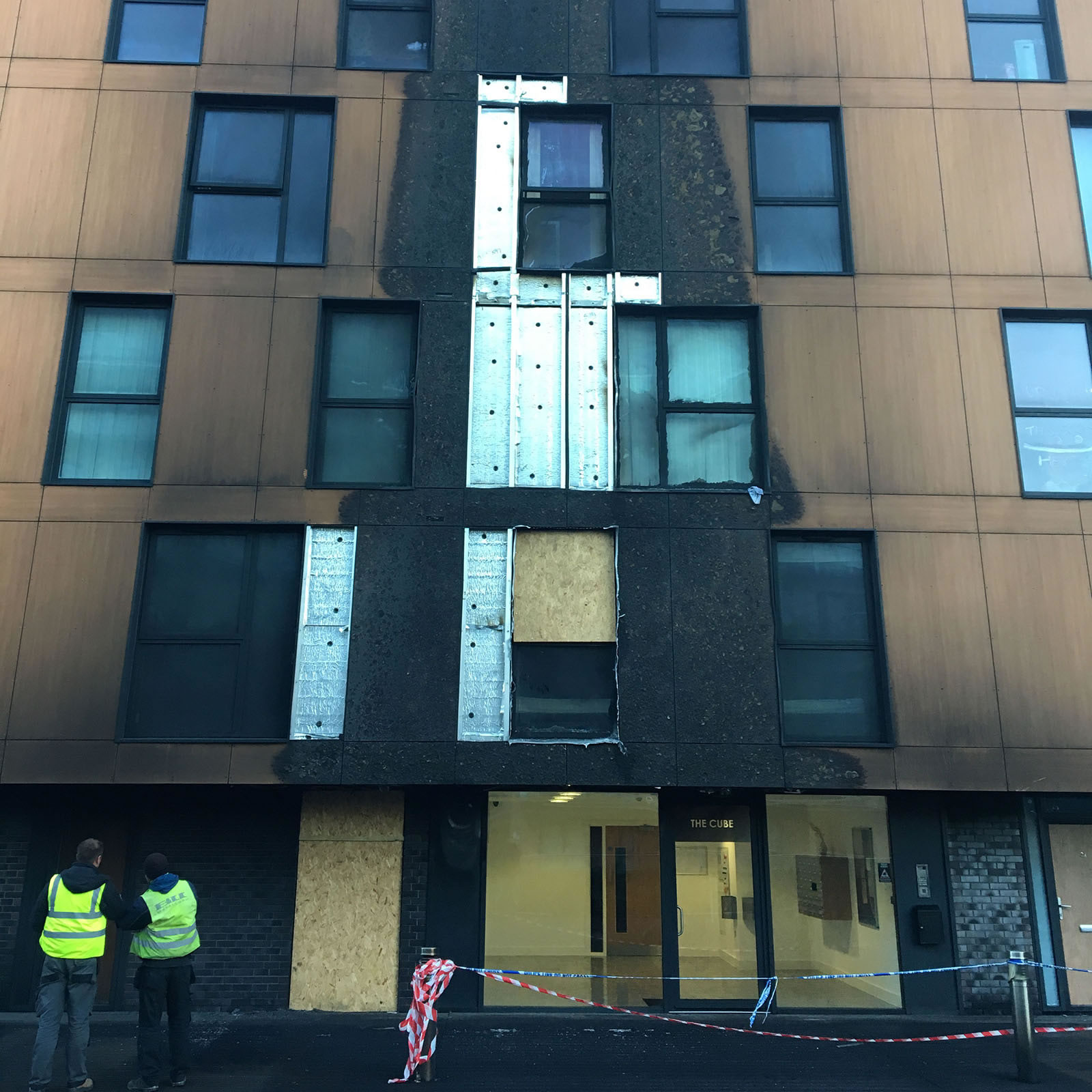
In England, cladding compliance depends on how the whole external wall performs.
It’s easy to get caught up in the visuals, like textures and how a building catches the light. But for developers, cladding that doesn’t meet the stringent demands of UK Building Regulations is a negative-value liability.
Planning Portal guidance makes clear that more extensive work to external walls can trigger building regulations and thermal upgrade requirements. Current dutyholder guidance places clear responsibilities on contractors to properly monitor compliance.
The right starting point is always the building itself: its use, height, risk profile, occupancy and construction constraints. For clients working on new builds or existing tenanted buildings, the goal is to deliver cladding that performs safely in its context.
Start with the building
The quote, unquote, ‘right’ cladding choice starts with the actual building.
Why? A new-build office, a refurbished block of flats, a low-rise commercial unit, and a higher-risk residential building will not all follow the same compliance route or share the same performance priorities.
You need to consider the building’s use, height, occupancy, fire strategy, and whether the work is taking place on a vacant site or an occupied, tenanted building.
That context shapes everything from material selection to detailing, sequencing and access for installation. It’s also essential to remember that major re-cladding work will usually trigger building regulations.
Planning Portal guidance states that where 25% or more of an external wall is re-rendered, re-clad, re-plastered, re-lined internally, or where 25% or more of the external leaf is rebuilt, the wall’s thermal insulation would need to be improved.
For existing multi-occupied residential buildings, if there’s uncertainty around external wall fire performance, a Fire Risk Appraisal of External Walls may also be required, using the PAS 9980 methodology (where appropriate).
What compliant cladding really has to achieve
Compliant cladding building regulations assess how the external wall system performs as a whole: the cladding face, insulation, cavity barriers, support rails, membranes, fixings, and junctions with windows, roofing, and other façade elements.
In other words, the right specification has to deliver four things at once:
-
Fire safety
Document B states that an external wall should not provide a medium for fire spread, and its guidance covers external surfaces and materials, as well as cavities and cavity barriers.
For some relevant buildings, Regulation 7(2) also tightens the rules so components in or on the external wall must achieve class A2-s1, d0 or A1, subject to specific exemptions.
-
Thermal performance
Part L sets standards for the energy performance of new and existing buildings, so the wall build-up has to limit heat loss.
-
Weather resistance
A compliant wall must keep the elements out.
Approved Document C requires external walls and cladding systems to resist precipitation and avoid carrying moisture into parts of the building that could be damaged. Wind-driven rain, cavity design, jointing and exposure are all relevant.
-
Structural integrity
Approved Document A is clear that wall cladding is a hazard if it becomes detached. The system must safely resist dead, imposed and wind loads, be securely fixed and supported, and use durable, corrosion-resistant fixings suited to the environment.
Why is installation and project team competence so essential?
A premium, fire-rated cladding panel is only as safe as the team installing it.
Compliance is a rigorous process, and the best-specified systems can fail if the design coordination is flawed. Under the current dutyholder regime, the legal landscape has shifted. Clients, designers, and contractors now share clear, non-delegable safety responsibilities.
For projects involving multiple parties, the appointment of a Principal Designer and Principal Contractor is essential to maintain control over compliance throughout the build.
On higher-risk buildings (HRBs), this is further reinforced by the ‘Golden Thread’ of information – a continuous record of design and construction decisions that proves the building was constructed as intended.
All of these elements play into the importance of competence and accountability. That’s why you need to choose a partner who understands these regulatory burdens and has the competence to manage them.
We treat compliance as an end-to-end workflow, and in doing so, we protect the building’s residents and the client’s long-term liability.
Choose a competent partner with Pops Facades
To meet building regulations, you need to choose a partner that understands the building and maintains compliance from survey through to handover.
We know that current government guidance places clear duties on contractors to monitor building work, with principal dutyholders required where there’s more than one designer or contractor, and stronger information requirements on higher-risk projects.
Luckily, Pops Facades is positioned to deliver exactly that kind of end-to-end service. If you’re planning a new facade package or replacing legacy cladding, Pops Facades can help you approach compliance as an interconnected process.
