
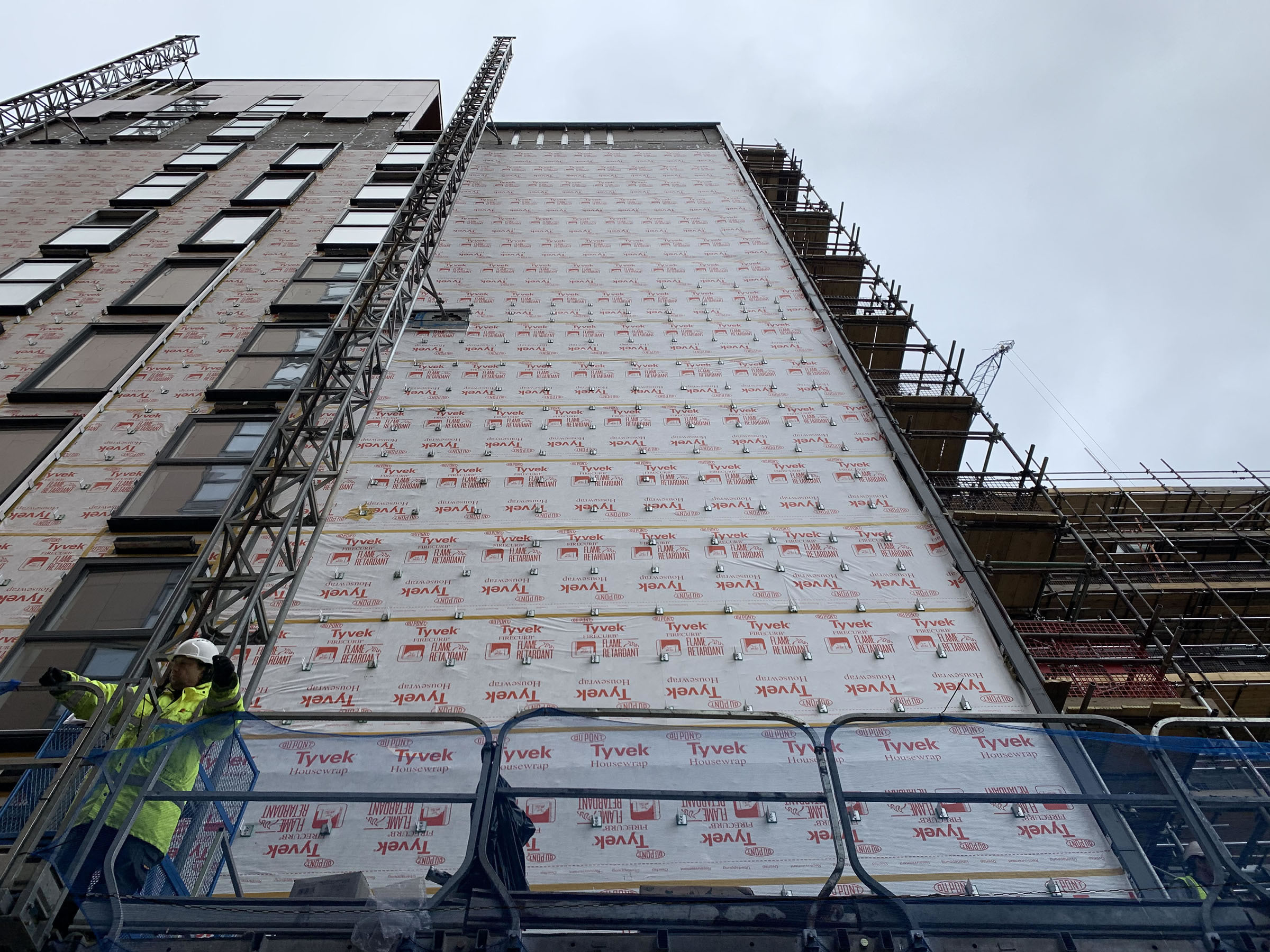
Fire safety compliance has become one of the most closely scrutinised parts of any UK building project.
In England, guidance continues to evolve (including scheduled updates to Approved Document B) and the expectation is clear: teams must be able to show, with evidence, that what’s been specified and installed will limit fire risk.
That pressure is even more intense on higher-risk buildings, where the Building Safety Regulator introduces formal stop/go points that can prevent a project from starting or being occupied without the right approvals.
At Pops Façades, we understand that, when you’re delivering a new-build or remediating an existing tenanted block, the questions are the same: Are these materials legal? Is the installation documented? And will this pass the next Gateway?
That’s why we’re breaking down the key rules shaping compliant roofing and external wall decisions in 2026.
The big shift: BS 476 vs. BS EN 13501-1
For years, the UK construction industry relied on ‘Class 0’ and ‘Class 1’ ratings under the BS 476 series. However, these national standards are being phased out in favour of the more rigorous BS EN 13501-1 (the Euroclass system).
As of 2026, relying on the old British Standards is no longer an option for compliance. The Euroclass system is now the language of fire safety.
Defining the new standards
The new standard (Euroclass): BS EN 13501-1 classifies products by reaction to fire using Euroclasses from A1 (best) down to F. The two you’ll see most in façade/cladding discussions are:
- A1 = non-combustible (no meaningful contribution to fire)
- A2 = limited combustibility (very limited contribution to fire)
You’ll often see extra markers, for example, A2-s1, d0:
- s1 = very limited smoke
- d0 = no flaming droplets
But why does this matter today? In England, combustible materials restrictions for certain in-scope buildings limit external wall materials (subject to exemptions) to A2-s1, d0, or A1 when classified under BS EN 13501-1.
Height matters: the 11-metre and 18-metre rules
18m is the key threshold for the combustible materials ban. Requirements also tighten from 11m upwards for certain residential fire-safety measures, and ADB includes specific external wall/balcony guidance for 11-18m blocks of flats.
Over 18-metres
Since 2018, the government has banned combustible materials in and on external walls of new blocks of flats, hospitals, residential care premises, and some other sleeping-risk buildings over 18m (scope later expanded to include hotels, hostels and boarding houses).
Every component (from the cladding panels and insulation down to the spacer bars) must meet the non-combustible standards (A1 or A2-s1, d0) we discussed earlier (subject to the regulation’s definitions and exemptions).
The 11-18 metre bracket
The ‘mid-rise’ bracket (11 to 18 metres) is where many existing tenanted buildings run into trouble.
Recent amendments to Approved Document B have tightened the rules for these structures. In practice, proposed changes can pull the whole external wall into sharper compliance focus, so assumptions based on what was there before don’t hold.
If you’re refurbishing an existing building in this height range, you’re often legally required to replace old, combustible systems with modern, fire-safe alternatives.
Under the Building Safety Act, projects must now pass through a rigorous ‘Gateway’ process overseen by the Building Safety Regulator (BSR):
- Gateway 2: You must secure building control approval before commencing building work.
- Gateway 3 (before occupation): You must obtain approval before occupation, demonstrating that the work complies and the building is safe to occupy.
The bottom line is that the height drives the rules: the higher the building (and the higher the sleeping risk), the less tolerance there is for combustible external wall materials.
Roofing regulations: more than just the top layer
UK regulations treat the roof as a complete engineered system, so when we talk about roof fire performance, it’s not enough to look at a membrane in isolation.
The whole-system test (BS EN 13501-5)
Under the European standard BS EN 13501-5, fire performance is assessed as a whole, and to achieve the highest rating, the entire assembly must be tested together; this includes:
- The structural deck
- The vapour control layer
- The insulation (thermal layer)
- The waterproof membrane and fixings
That’s why you’ll see ratings like BROOF(t4) tied to specific system configurations, not generic product labels.
The refurbishment trap
If you are managing an existing building, you must be aware of the NFRC’s 50% Rule. Under Part L of the Building Regulations, if you refurbish/replace more than 50% of a roof’s surface area, you’re legally required to:
- Upgrade thermal performance: Bring the roof up to current U-value standards.
- Verify fire compliance: Verify that the new system meets modern safety standards, even if the original roof didn’t.
It’s here that run-of-the-mill repairs can turn into major compliance projects. Failing to meet these standards can result in the Building Safety Regulator (BSR) refusing to sign off on the works.
Health, safety, and the Golden Thread
The 2026 regulatory environment places as much emphasis on how you work and what you record as it does on the materials themselves.
HSG33 compliance
For example, for safe roof work on live sites, the Health and Safety Executive makes it clear in HSG33 that roof work must be planned to prevent falls (especially where fragile surfaces may be present).
On tenanted buildings, the risk profile is even higher because you’re also managing public safety: routes, entrances, and exclusion zones must be controlled, so that people aren’t exposed to falling materials.
The golden thread of information
Compliance doesn’t stop there: it also has to be provable.
For higher-risk buildings, government guidance requires a digital record of building safety information (often referred to as the golden thread) so any element that was designed, installed, and changed can be traced back.
Regulation 38 of the Building Regulations also requires the person carrying out the work to provide fire safety information to the ‘responsible person’ by completion (or first occupation, if earlier).
Don’t leave compliance to chance – future-proof your building envelope!
Need certainty before you commit? Pops Façades supports clients with an end-to-end approach – co-ordinating roofing, cladding, and critical interfaces, so that performance doesn’t fall apart.
Talk to Pops Façades if you need support with compliant handover. We can provide as-built records and photographic evidence, alongside site reporting to support sign-off.
